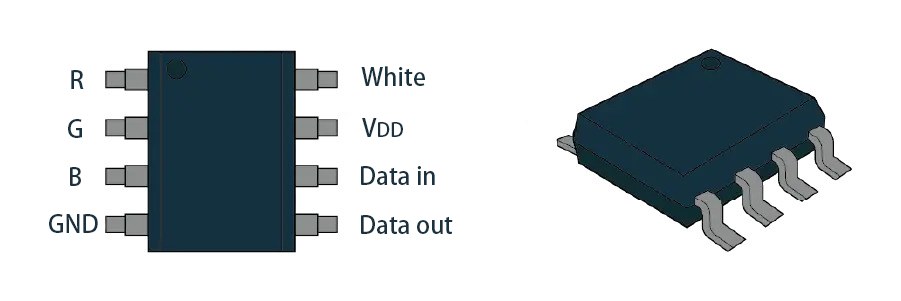
All three are external, single-wire, 4-channel constant-current LED driver ICs used in RGBW addressable strips.
One data line: DIN → DOUT
Four outputs: R, G, B, W
Common in 12V/24V pixel tape where several LEDs share one IC
No clock line — timing is encoded in the data stream
Usually 8-bit per channel = 32-bit RGBW = 256 grayscale levels
They are notthe same as SK6812 RGBW (5V, integrated LED+IC), and they are notmutually interchangeable even if the pinout looks similar.
Side-by-Side Comparison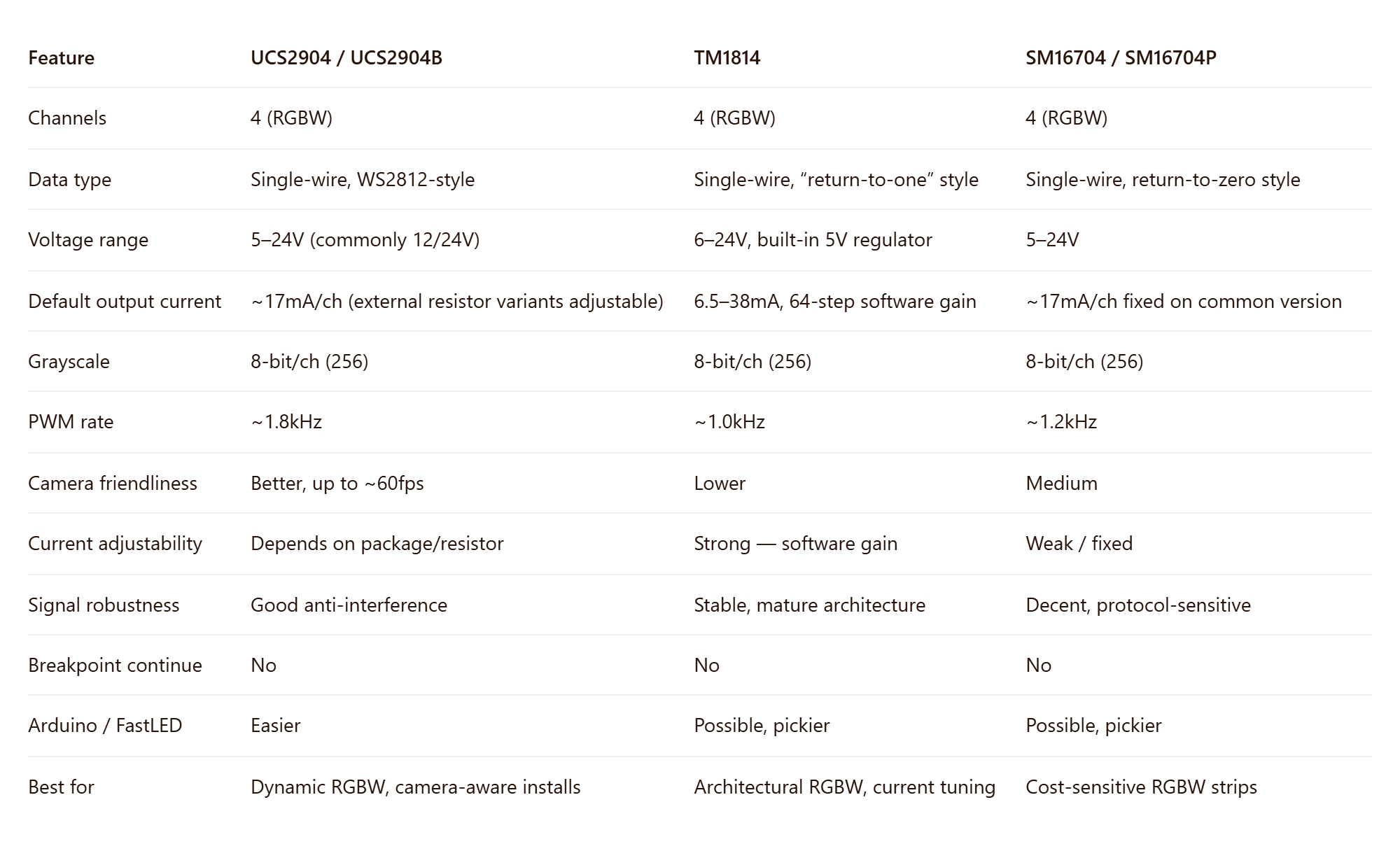
UCS2904 is often the safest choice when you care about visual quality rather than deep current tuning.
Higher PWM rate (~1.8kHz) than TM1814/SM16704
Better behavior under video capture — rated around 60fps before flicker becomes risky
Wide 5–24V operation, good for 12V/24V long-run strips
Clean RGBW mixing: true white channel instead of faking white from RGB
Generally easier to get working with Arduino/FastLED/WLED setups
Still 8-bit per channel — not as smooth as 12-bit/16-bit chips like WS2814 or UCS7604
No breakpoint-continue: one dead pixel can kill the downstream chain
Current adjustability depends on exact variant/package
“UCS2904” vs “UCS2904B” labeling is not always consistent across factories
Use UCS2904 if:
You’re building RGBW cove lighting, retail displays, stage accents, or architectural washes where white tone matters and someone might film it.
TM1814 from Titan Micro is extremely common in architectural and facade lighting.
Built-in 5V regulator for 6–24V operation
Constant-current accuracy is good: ~±3% channel-to-channel, ~±5% chip-to-chip
Software-adjustable current gain: 6.5mA → 38mA in 64 steps
Mature, widely manufactured, often stable over long cascades
Great when you want consistent brightness across many pixels
Lower PWM rate (~1kHz)
More sensitive controller/timing expectations than UCS2904
No redundant data path
8-bit grayscale only — pastel dimming is not studio-grade
Different timing scheme from UCS2904/SM16704, so “they’re all RGBW SPI” is misleading
Use TM1814 if:
You’re doing building façades,护栏管/point sources, long decorative runs, or projects where current matching and regulator integration matter more than max PWM smoothness.
SM16704 is the one you often see when a factory says “same function, lower price.”
Same RGBW single-wire concept
5–24V support
800kbps data rate
Simple peripheral circuit, SOP8
Cheaper BOM in many strip designs
Default ~17mA fixed current on common versions
Less flexible than TM1814
PWM ~1.2kHz — better than TM1814, still behind UCS2904
Protocol/timing quirks make controller compatibility less forgiving
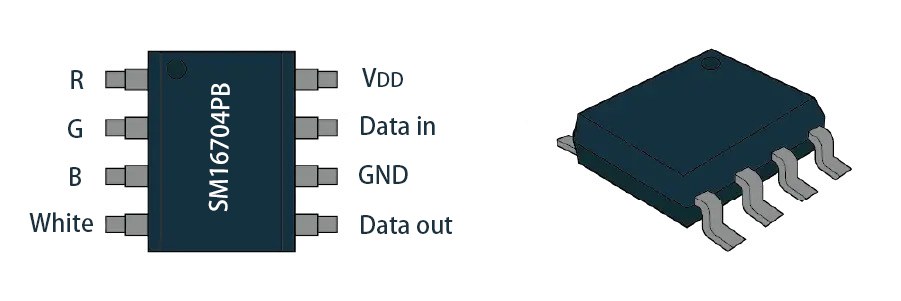
“SM16704” vs “SM16704P” vs “SM16704PB” pinouts can trip you up
Use SM16704 if:
You’re doing cost-sensitive RGBW decoration, signage, or bulk pixel tape where the controller is known and you don’t need fine current tuning.
They are not protocol-compatible.
UCS2904 uses WS2812-style timing
TM1814 uses its own return-to-one single-wire scheme
SM16704 uses return-to-zero single-line SID timing
If your controller supports “RGBW SPI,” that still doesn’t guarantee TM1814/UCS2904/SM16704 all work. You need the controller or library to explicitly list the chip.
Also: none of these have breakpoint-continue. If you need “one pixel dies but the rest keep working,” move to WS2814 or UCS7604 instead.
You want the best out-of-the-box RGBW smoothness
Camera/film/event use is likely
You’re using Arduino / FastLED / WLED
You want 12V/24V long runs with fewer injection headaches
You need adjustable constant current
You want built-in regulation and mature architectural-grade behavior
Brightness consistency across pixels matters
You already have a TM1814-compatible controller
Budget is the main constraint
The project is decorative, not camera-critical
Your controller/strip combo is already validated
You don’t need software current gain
If you ask me for a default recommendation:
UCS2904 = best general-purpose RGBW pixel IC
TM1814 = best when current control / regulation / architecture matters
SM16704 = best when price matters and the system is already proven
None of them are “bad.” They’re just optimized for different things: UCS2904 for smoothness, TM1814 for control precision, SM16704 for cost.
If your project involves cameras, stage, retail, or high-end interior RGBW → UCS2904.
If it involves buildings, façades, and current matching → TM1814.
If it involves bulk decorative strips and tight margins → SM16704.
