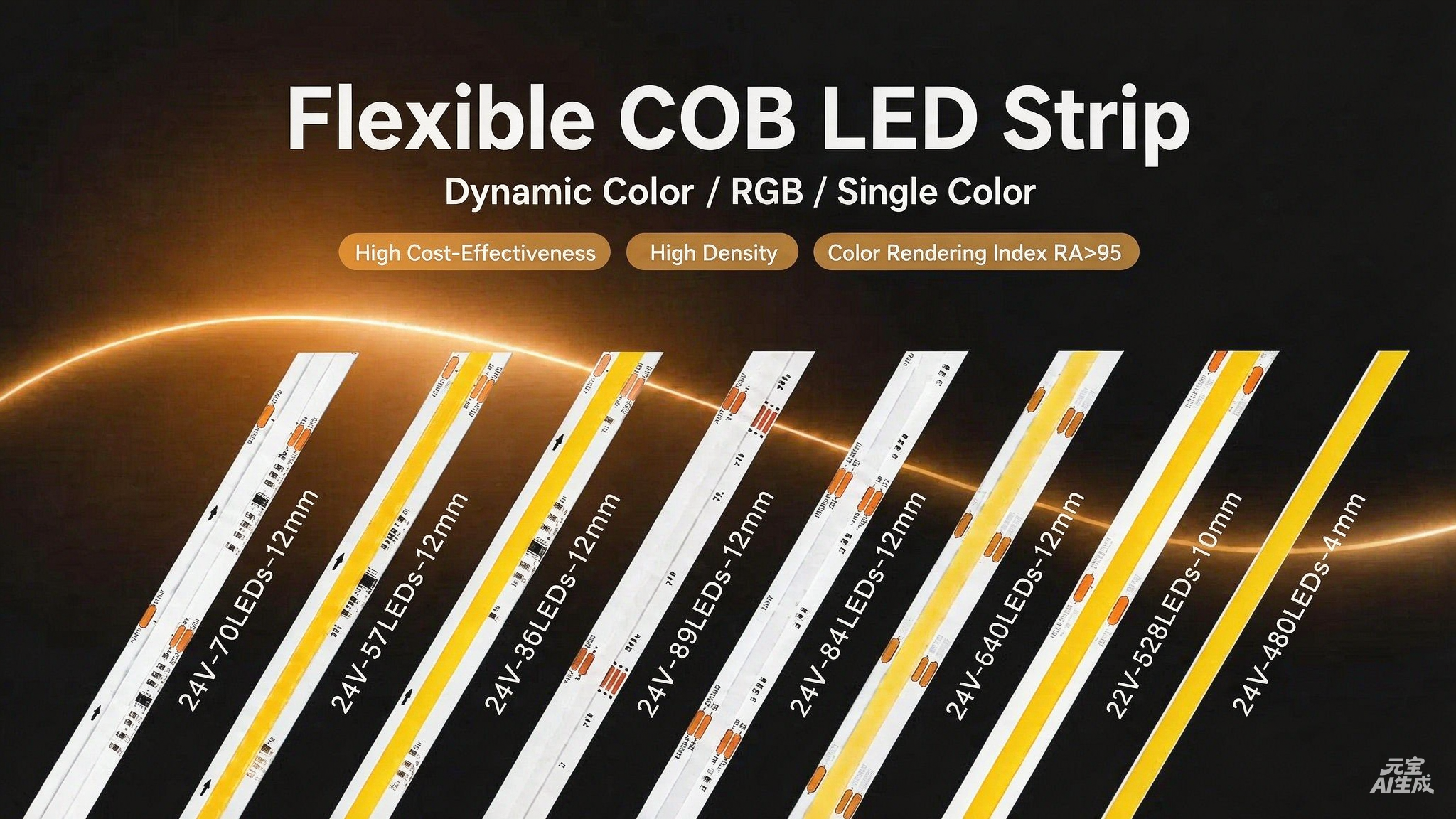
COB LED strips have made this question even more relevant. Because Chip-on-Board technology packs hundreds of tiny chips closely together, the result is a smooth, dot-free line of light. That makes COB strips attractive for architecture, retail, hospitality, residential coves, and high-end decorative installs. But COB is not one product—it’s a packaging technology that comes in very different color systems.
This guide breaks down the main COB strip color families—Single White → CCT → RGB → RGBW → RGB+CCT → Pixel COB—and helps you specify the right one instead of overbuying features you’ll never use.
Traditional SMD strips show individual bright points. Up close, you see dots. COB strips place many chips under a phosphor layer, so the output looks like one continuous glowing line.
That matters for color choice because:
White COB looks more like a linear fixture than a “LED tape”
CCT shifts look smoother and less patchy
RGB COB gives neon-like color washes without visible pixels
RGBW / RGB+CCT COB can act as both ambient white lightingand decorative color lighting
Pixel COB turns a seamless strip into a programmable media surface
So the decision is no longer “LED strip or not.” It’s:
Do I need illumination, atmosphere, color, programmability—or all of them?
This is the safest, most reliable, and most underrated option.
A single-color COB strip emits one fixed white temperature:
2700K–3000K warm white → residential, hotel, restaurant, lounge
3500K–4000K neutral white → office, retail, kitchen, commercial interior
5000K–6500K cool white → task lighting, industrial, display, workspace
cabinet lighting
office linear lighting
architectural cove lighting
furniture lighting
retail shelving
anywhere white quality matters more than effects
highest optical uniformity
no controller needed for basic on/off/dim
fewer failure points
best CRI options for accurate color rendering
lowest lifetime maintenance cost
If the strip is meant to light the space, not entertain it, single white COB is often the correct answer.
CCT COB strips put warm-white and cool-white chips on the same tape. A CCT controller lets you move from candlelight warmth to daylight crispness.
Typical range: 2700K → 6500K.
smart homes
hotel rooms
residential living spaces
meeting rooms
restaurants and lobbies
circadian / human-centric lighting
One strip replaces several fixed-white products. Morning = cooler and more alert. Evening = warmer and more relaxing.
needs a CCT/tunable-white controller
slightly more expensive than fixed white
still no RGB color
Choose CCT when the project is about white light that adapts, not rainbow color.
RGB COB strips mix red, green, and blue to create millions of colors. Because the chips are dense and diffused, the color wash looks smooth—great for mood lighting.
But here’s the classic trap:
RGB white is mixed white. It is usually cool, slightly blue/violet, and not suitable as serious task or architectural white light.
entertainment spaces
bars, KTV, gaming rooms
event decoration
backlighting
creative commercial decoration
accent walls
kitchens
offices
retail product lighting
makeup / photography
any space where white must look clean
RGB COB is the cheapest color option, but if someone later says “can it also do nice white?”, the answer is disappointing.
RGBW adds a dedicated white chip next to red/green/blue.
Now you get:
full color mode for parties/decor
dedicated white mode for usable illumination
The white channel is usually fixed: 2700K warm or 4000K neutral most commonly.
kitchens / under-cabinet
retail displays
hospitality venues
bars that also need service lighting
multifunction residential spaces
bathroom vanities and feature shelves
Mixed RGB white wastes energy and looks artificial. A real white channel is brighter, cleaner, and more comfortable.
4-channel controller required
more costly than RGB
white temperature is fixed unless you move to RGB+CCT
If you want “color when I want it, proper white when I need it,” RGBW is the practical sweet spot.
RGB+CCT adds two white channels: warm white + cool white.
Control channels:
R
G
B
WW (warm white)
CW (cool white)
That means the strip can do:
millions of colors
2700K–6500K tunable white
circadian lighting
scene-based smart control
This is the most versatile non-pixel COB option.
luxury hotels
premium residential
architectural lighting
smart-building projects
restaurants with daytime + nighttime scenes
wellness, spa, and high-end retail
5-channel controller
higher cost
more complex commissioning
easier to misconfigure than RGBW
RGB+CCT is not “better RGB.” It’s a lighting-design tool: color accents plus professional white control in one tape.
Pixel COB strips combine COB’s dot-free appearance with addressable ICs such as WS2812B, SK6812, WS2813, WS2815, etc.
Variants include:
Pixel RGB COB
Pixel RGBW COB
Pixel RGB+CCT COB
running/chasing effects
gradients
scrolling text
music sync
mapped animations
individual segment/pixel control
stage lighting
media facades
creative architecture
event design
smart installations
entertainment venues
Pixel COB still inherits addressable-strip realities:
data timing / controller load
power injection
IC reliability
backup-data needs for permanent installs
RGB-only pixels still have weak white unless RGBW/RGBCCT
Pixel COB is for experiences and media, not just room lighting.
|
Type |
Channels |
White quality |
Color effects |
Complexity |
Best use |
|---|---|---|---|---|---|
|
Single White COB |
1 |
Excellent |
None |
Low |
task / architectural white |
|
CCT COB |
2 white |
Excellent, tunable |
None |
Medium |
hotels, homes, offices |
|
RGB COB |
3 |
Poor/mixed |
Strong |
Medium |
entertainment, accent |
|
RGBW COB |
4 |
Good, fixed white |
Strong |
Medium-high |
kitchens, retail, hospitality |
|
RGB+CCT COB |
5 |
Excellent, tunable |
Strong |
High |
luxury/smart architecture |
|
Pixel COB |
IC-dependent |
Depends on variant |
Programmable |
High |
stage, media, creative installs |
Lighting → white or CCT
Decoration → RGB
Both → RGBW or RGB+CCT
If clients, cameras, products, or skin tones matter → avoid plain RGB.
Yes → CCT or RGB+CCT
No → fixed white
Permanent → prioritize reliability: white, CCT, RGBW, RGBCCT, backup-data pixel COB
Temporary → RGB or pixel COB is fine
A homeowner can handle RGBW. A facility manager wants simple, documented, serviceable control—often CCT or DMX/SPI-managed RGBW/RGBCCT.
Office cove / cabinet / retail shelf
→ Single white COB, 3000K / 4000K, CRI 90+, 24V
Hotel room / restaurant
→ CCT COB 2700K–5000K, 24V, dimmable driver
Gaming room / bar / event space
→ RGB COB or pixel RGB COB
Kitchen / vanity / multipurpose retail
→ RGBW COB, 24V, 4-channel controller
Luxury residence / lobby / media wall
→ RGB+CCT COB or pixel RGB+CCT COB with professional controller
Stage / facade / brand experience
→ Pixel COB + SPI/DMX architecture
Buying RGB, then complaining white looks blue
Buying RGB+CCT for a corridor that only needs 4000K
Buying pixel COB for a bedroom and creating maintenance pain
Ignoring CRI—high CRI matters more than channel count for white light
Forgetting controller compatibility: RGB controller ≠ RGBW controller ≠ CCT controller ≠ RGBCCT controller
Assuming “COB” means addressable—COB is packaging, not control type
COB LED strips are not “RGB strips with no dots.” They are a platform.
White COB = professional illumination
CCT COB = adaptive white lighting
RGB COB = mood and color
RGBW COB = color + usable white
RGB+CCT COB = full creative + architectural control
Pixel COB = programmable media surface
The right choice is not the one with the most channels. It’s the one matched to:
lighting purpose + viewer distance + white-light quality + control system + maintenance model
If you remember one sentence:
Single white lights the room, CCT shapes the mood, RGB entertains, RGBW balances both, RGB+CCT does everything non-pixel, and pixel COB turns the strip into a screen.
